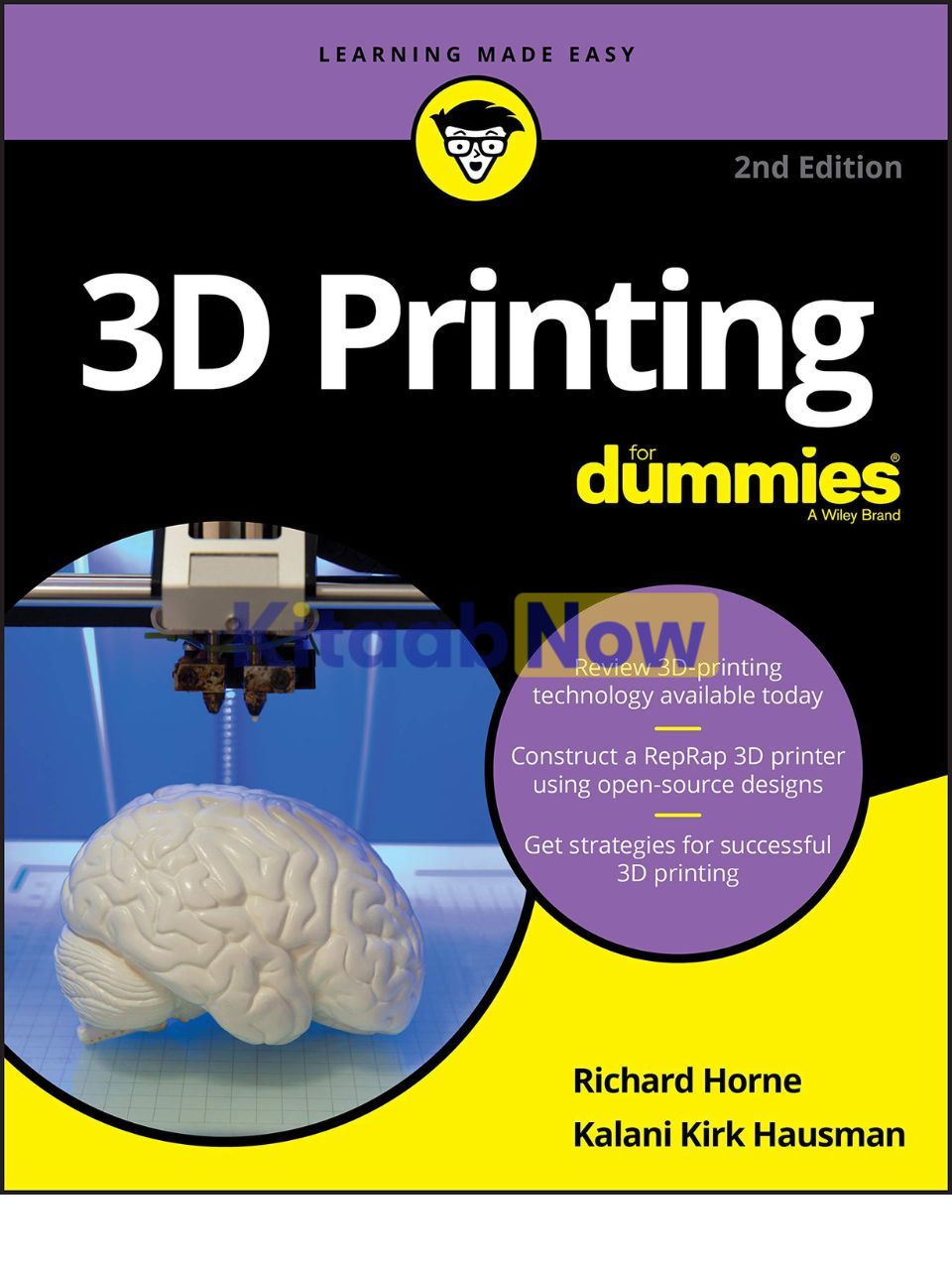
3D Printing for Dummies (2nd Edition)
$ 7.88
DescriptionThe bestselling book on 3D printing3D printing is one of the coolest inventions we’ve seen in our lifetime, and now you can join the ranks of businesspeople, entrepreneurs, and hobbyists who use it to do everything from printing foods and candles to replacement parts for older technologies—and tons of mind-blowing stuff in between! With 3D Printing For Dummies at the helm, you’ll find all the fast and easy-to-follow guidance you need to grasp the methods available to create 3D printable objects using software, 3D scanners, and even photographs through open source software applications like 123D Catch.Thanks to the growing availability of 3D printers, this remarkable technology is coming to the masses, and there’s no time like the present to let your imagination run wild and actually create whatever you dream up—quickly and inexpensively. When it comes to 3D printing, the sky’s the limit!Key FeaturesCovers each type of 3D printing technology available today: stereolithology, selective sintering, used deposition, and granular bindingProvides information on the potential for the transformation of production and manufacturing, reuse and recycling, intellectual property design controls, and the commoditization of productsWalks you through the process of creating a RepRap printer using open source designs, software, and hardwareOffers strategies for improved success in 3D printingOn your marks, get set, innovate!Table of ContentsIntroduction 1About This Book 2Foolish Assumptions 2Icons Used in This Book 3Beyond the Book 4Where to Go from Here 4Part 1: Getting Started with 3D Printing 5Chapter 1: Seeing How 3D Printers Fit into Modern Manufacturing 7Embracing Additive Manufacturing 8Defining additive manufacturing 9Contrasting with traditional manufacturing 10Understanding the advantages of additive manufacturing 13Exploring the Applications of 3D Printing 17Working with RepRap 18Chapter 2: Exploring the Types of 3D Printing 19Exploring Basic Forms of Additive Manufacturing 19Photopolymers 20Granular powders 24Laminates 27Filament-based production 28Understanding the Limitations of Current Technologies 29Considering fabrication rates 29Exploring size constraints 30Identifying object design constraints 30Understanding material restrictions 31Chapter 3: Exploring Applications of 3D Printing 33Looking at Current Uses of 3D Printing 34Rapid prototyping 34Direct digital fabrication 35Restoration and repair 36Designing for the Future with 3D Printing 39Household goods 39Buildings 40Bridges 43Examining Molding and Casting through 3D Printing 43Lost-material casting 43Sintered metal infusion 44Applying Artistic Touches and Personalization 44Medical implants 44Biological implants (organs) 46Item personalization 46Clothing and textiles 46Customizing Designs on the Fly 48Military operations 48Space 49Part 2: Outlining 3D-Printing Resources 51Chapter 4: Identifying Available Materials for 3D Printing 53Exploring Extruded Materials 54Thermoplastics 55Experimental materials 59Extruded alternatives 59Identifying Granular Materials 61Plastic powders 61Sugar and salt 61Metal powders 62Sand and natural granular materials 63Exploring Photo-Cured Resins 64Understanding Bioprinting 65Bioprinting food and animal products 66Replacement tissues and organs 67Identifying Other Uses for Materials 67Recycling materials 68Producing food 68Caring for people 69Chapter 5: Identifying Sources for 3D-Printable Objects 71Exploring Object Repositories 72Vendor repositories 72Community repositories 74Designing in the Computer 75Scanning Objects 78Capturing Structure from Photographs 82Preparing Models for Printing 853D model viewers 86Mesh modelers 86Mesh repairers 86Part 3: Exploring the Business Side of 3D Printing 87Chapter 6: Commoditizing 3D Printing 89Democratizing Manufacturing 89Derived designs 90Curated artifacts 90Expanded opportunities 91Establishing Personal Storefronts 94Creating a unique design 94Fabricating a unique product on demand 96Creating “Impossible” Objects 98Building New Tools 99Moving beyond solid blocks 99Creating the tool that will create the tool 100Chapter 7: Understanding 3D Printing’s Effect on Traditional Lines of Business 103Transforming Production 103Displacing the production line 104Abbreviating the manufacturing chain 105Providing local fabrication 106Eliminating traditional release cycles 107Challenging Intellectual Property Laws 107Threatening IP protections 108Assigning legal liability 110Leveraging Expired Patents 110Working around patents 111Protecting intellectual property rights 112Imposing Ethical Controls 113Chapter 8: Reviewing 3D-Printing Research 115Building Fundamental Technologies 115Crafting educational tools 116Expanding 3D-printing options 118Creating 3D-printed electronics 119Creating Functional Designs 119Drones, robots, and military applications 120Von Neumann machines 121Expanding Material Selection 122Supporting Long Space Voyages 123Creating Medical Opportunities 125Part 4: Employing Personal 3D-Printing Devices 127Chapter 9: Exploring 3D-Printed Artwork 129Adorning the Body 129Personalizing Your Environment 131Incorporating Individualism in Design 132Visualizing the Abstract 134Sharing Art 136Chapter 10: Considering Consumer-Level 3D Printers 139Examining Cartesian 3D Printers 140Exploring Delta Options 143Understanding Polar Fabrication 146Getting to Know SCARA and Robot Arm Motion 147Building Emerging Alternatives 148Open innovation and community designs 151Examining Printers for Flexible Materials 152Understanding Shore ratings 152Printing with soft filaments 153Sampling 3D Food Printers 154Going beyond RepRap 159Prusa i3 MK2 159Sigma 160Printrbot Simple Metal 161LulzBot Taz 6 161Ultimaker 3 162MakerBot 163Chapter 11: Deciding on a RepRap of Your Own 165Evaluating Your 3D Printing Needs 166Do you want a RepRap or another 3D printer? 166Do you buy a ready-built 3D printer or use a kit? 167Licensing and Attribution 168Selecting a 3D Printer Design 171RepRap designs 171Home 3D printer kits and self-sourcing 176Experimental designs 179Choosing Print Media 181Thermoplastic 181PLA/PHA plastic 183ABS 185PET 185Composite or filled materials 186Paste 187Identifying Components 189Structural framework 189Extruder 189Build plate 193Control electronics 194Software 195Simplify3D 197Part 5: Creating a RepRap 3D Printer 201Chapter 12: Assembling Structural Elements 203Locating Materials 203Kits 204Self-sourcing 206Printing your own 207Ask the community 207Online marketplaces 207Obtaining Printed Parts for Machine Assembly 208Understanding the Machine Motion 209Z-axis motion 210X and Y motion 212Building the Frame Structure 214Assembling the Prusa i3 Y-Axis Frame 219Assembling the Moving Axis 220Assembling the Prusa i3 moving Y axis 223Assembling the Prusa i3 moving Z and X axes 224Joining the Z, X, and Y axes 227Sensing the Home Position 228Chapter 13: Understanding RepRap Control Electronics 231Understanding RepRap Electronics 231RAMPS 232RAMBo 232Sanguinololu 234Minitronics 234RUMBA 235Elefu-RA V3 235Megatronics 236Adding Electronics to Your RepRap 3D Printer 238Preparing for electronics assembly 238Fitting the positional sensors to the frame 239Fitting the heated bed to the Y carriage 241Preparing and fitting the main electronics 242Preparing and connecting the power supply 243Connecting the motor and position-sensing wiring 244Adding Modular Components, Sensors, and Motors 246Printing without a computer 246Installing stepper-motor driver modules 246Selecting position-sensing modules 249Identifying power-supply requirements 250Installing add-ons 253Connecting RepRap Wiring 255Configuring Firmware 256Configuring Prusa i3 firmware 258Uploading Marlin firmware to RAMPS electronics 263Chapter 14: Assembling the RepRap Extruder 265Thermoplastic Extrusion 265Filament drive mechanism 266Idler wheel 270Prusa i3 Extruder and Hot-End Assembly 273Fitting the filament drive to the motor shaft 273Assembling the extruder idler pressure bearing 273Fitting the J-head hot-end 274Fitting the assembled extruder to the X carriage 274Wiring the extruder to RAMPS 275Multicolor Print Methods 279Toothpaste effect 280Three-way color mixing 280Two-color printing 281Layer-selective color printing 282Cut-and-follow-on printing 283Extruder Operation and Upgrades 286Fixing a blocked hot-end or extruder 288Acquiring an assortment of extruders 289Cooling extruders with fans 291Chapter 15: Identifying Software and Calibrating Your 3D Printer 295Finding 3D Design Software and Models 295Using design software 301Verifying models with Netfabb 303Working with Slic3r 305Configuring Slic3r 305Processing models with Slic3r 308Calibrating Your 3D Printer 315Leveling your print bed 316Tuning your hot-end temperature control 318Calibrating extruder distance 318Printing Objects 322Printing vases, pots, and cups 326Printing large single-piece objects 328Printing tiny or highly detailed objects 328Printing many objects at the same time 329Improving print quality 330Chapter 16: Refining the Design and 3D-Printing Process 331Being Productive with 3D Printing 331Refining Your Print Preparations 333Examining a Design Example 336Designing Parts for 3D Printing 340Material 341Orientation 342Layer height 344Nozzle size and perimeter outlines 344Infill level 344Postprocessing, Recycling, and Finishing an Object 346Manual finishing 346Assisted finishing 347Coatings 348Printing Big: Bonding and Joining Parts 349Recycling 351Using a Web-Based 3D-Printing Interface 354OctoPrint 354Duet 354Part 6: The Part of Tens 355Chapter 17: Ten Examples of Direct Digital Manufacturing and Personalization 357Producing 3D-Printed Food 357Printing Tissues and Organs 358Fashioning Biological Replicas 358Crafting Clothing and Footwear 359Customizing Jewelry 360Making Hollywood Spectacular 360Creating Structures 361Reaching beyond the Sky 361Constructing Robots 362Printing 3D Printers 363Chapter 18: Ten Impossible Designs Created Using Additive Manufacturing 365Personalized Objects 365Medical Implants 367Dental Repair 367Self-Deploying Robots 368Printed Drones and Aircraft Parts 368On-Demand, On-Site Manufacturing 369Custom Objects Created in Space 369Art on Demand 370Locally Fabricated Items 370Body Parts 371Index 373Authors BiographyRichard Horne (RichRap) has worked as an engineer, marketer, and product designer. He blogs and shares ideas on making 3D printing easier for everyone.Kalani Kirk Hausman has experience as an IT consultant, enterprise architect, auditor, and ISO. He conducts research on integrating 3D-printed materials into educational curricula.
Related products
-
 Affordable Housing for Smart VillagesAdd to basket
 -
 Aeronautical Telecommunications Network: Advances, Challenges, and ModelingSelect options
 -
 Affordable Reliability Engineering: Life-Cycle Cost Analysis for Sustainability & Logistical SupportAdd to basket
 -
 Aerospace Project Management HandbookSelect options